
If the brief is “our favorite visit photo, our two current locations, and a meaningful date,” the couple-photo and current-location map canvas is the direct choice. Its composition already brings those elements together. The useful buying work is deciding what each input should contribute so the finished piece tells one story.
Let the photograph show the time together, the maps show where you live apart now, the names identify the people, and the date anchor a real memory. That division prevents the available fields from turning into four separate stories. Choose the complete romantic design, including its wording about being together again, rather than imagining an unadorned photo print.
The photograph: choose the shared interval
A visit picture does not have to show a landmark. The maps already add geographic context, so the photograph can concentrate on recognizable people and a moment the recipient enjoys. Choose an image that remains meaningful within the surrounding composition.
A favorite visit picture shows you in the same place for a moment. The two maps can explain the separate places around that moment. Together, they give the photograph a long-distance context without requiring a lengthy account of the relationship.
That combination works especially well when the visit had a clear identity: the first time one partner explored the other's city, a familiar weekend reunion, or a trip you both keep referring to. The photograph is the memory; the maps are the geography that makes the memory distinctive.
You do not need the most dramatic picture from the trip. The canvas is likely to become part of the recipient's normal surroundings, so choose an image they want to see repeatedly. A relaxed portrait can be more suitable than a scenic photograph in which the two of you are barely visible.
The retailer illustration shows a couple photograph between two heart-shaped maps. Names and a special date are also available for personalization. This is a composed romantic design, rather than an unadorned photo print with a map added as an optional afterthought.
That distinction helps you decide whether it fits the recipient. Someone who likes personalized relationship art may enjoy the combined elements. Someone who wants only a photograph with no surrounding symbols may prefer a different style of artwork. Buy this canvas for the way the photo and maps work together.

Personalize the Distance Means So Little photo canvas
The maps: show the homes around the memory
Current homes are the clearest fit for this design’s present-separation message. If the photo came from a third location, that place can remain in the photographed memory while the maps show your usual separate lives. Do not choose a past destination merely because it looks more romantic on a map.
For a visit between two current homes, those homes are usually the clearest map subjects. They tell the recipient how the photographed moment fits within the relationship now. The design does not have to record every destination reached during the trip.
If the photograph was taken in a third place, the maps can still represent your respective homes, provided that is the story you intend. The central image then shows where you met, while the maps show where you normally live. A separate note can explain that connection if it would otherwise be unclear.
Avoid choosing locations simply because they sound more romantic. A familiar city with a personal meaning is more useful than a famous place that played little role in the visit. The strongest customization makes the composition recognizably yours.
The date: anchor rather than overcrowd the story
Give the date one understandable job. It can name the visit or another relevant relationship moment, but it does not need to stand for the birthday, the move, and the trip at once. A separate note can explain why the picture belongs to the occasion when you give it.
The special date should support the same memory. It might identify the visit or a meaningful day within it. There is no need to make one date stand for several unrelated milestones when the photograph already gives the piece a focused subject.
The object: select the complete scale and finish
The central photograph is only part of the canvas area. When deciding size, assess the whole photo-map-and-text design. Choose framing according to whether the recipient wants a finished gift or enjoys controlling that finishing choice.
The available sizes are 8 × 12, 12 × 18, 16 × 24, and 24 × 36 inches. Those dimensions apply to the canvas choice, not just the central image. The maps and personal text share the composition, so consider the complete piece when choosing its role on the wall.
The smaller sizes can suit a personal picture grouping, while larger sizes are candidates for a more prominent display. A large format is sensible when the recipient wants this particular relationship artwork to be a focus. It is less sensible when you only know that there is an empty wall somewhere in the home.
Heldinside describes the framed canvas as ready to hang. The unframed option arrives rolled in a tube. If your aim is to give a finished keepsake for a known wall, framed is the more straightforward selection.
Unframed can be appropriate when your partner enjoys choosing frames or has a particular display plan. In that case, the extra choice is part of the appeal. It is less suitable when you want the recipient to open the gift and have a complete display piece without another project.
Think about this distinction before comparing size. A modest framed canvas that suits the room can be a more complete gift than a much larger rolled canvas with no agreed presentation. Format and scale should both serve the way the recipient wants to live with the image.
Only change to the light if the brief changes
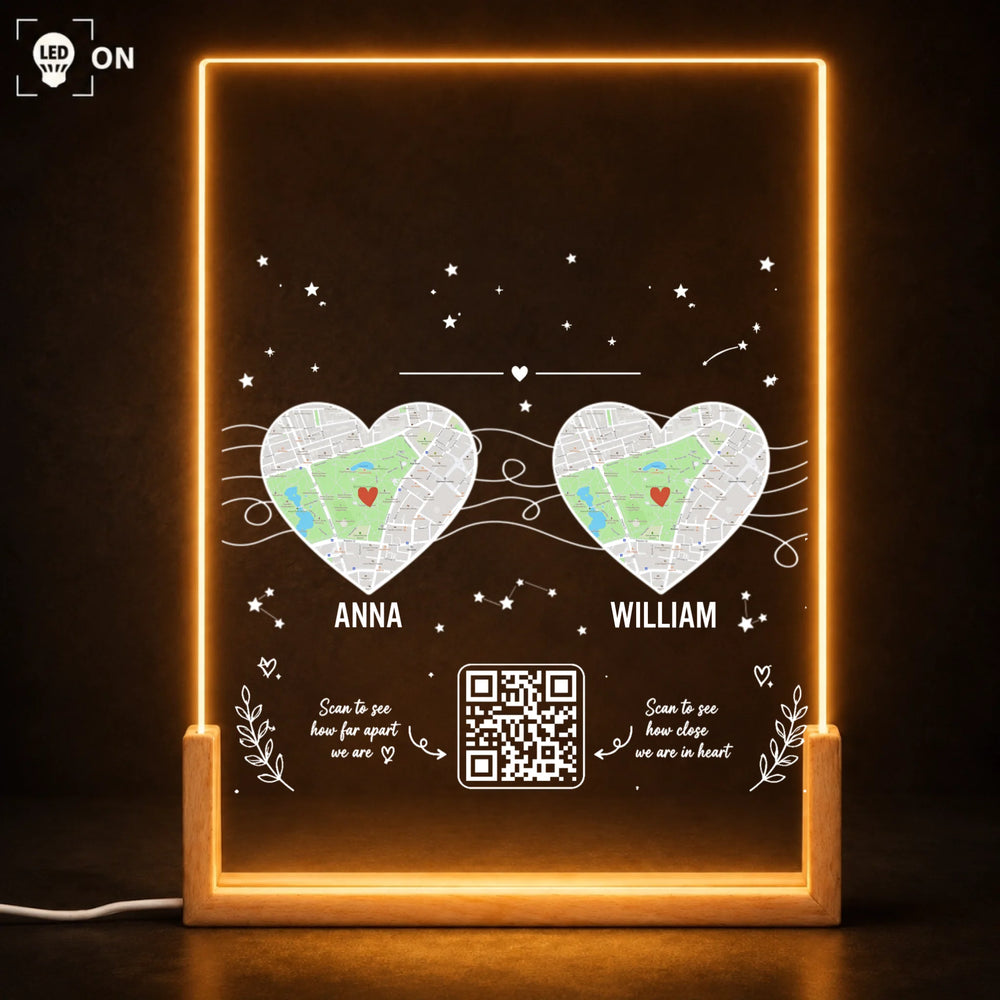
The personalized two-location map light is the alternative when the current cities are the real subject and the photograph is optional. Its maps should still represent present separation. If the visit image was the essential reason for shopping, changing to a map-only design would give up the very thing you wanted to preserve.
The Distance Means So Little night light uses two heart-shaped maps and names without making a couple photo the centerpiece. It has an optical acrylic panel, a natural wood base, and USB power. Its listed sizes are 5 × 7 and 6 × 8 inches, with Moonlight as the current light-color option.
The tradeoff is that the favorite visit photo is no longer the visible main subject. That is acceptable when the map idea is more important, but it is a compromise if the photograph was the reason you began shopping. Do not change formats simply because the light seems smaller or easier to select.
Your purchase direction
For a photo-led visit gift, choose the canvas and keep every personal detail pointed at the same memory. The map light is useful only when you discover that the places matter more than the picture. A direct brief deserves a direct recommendation.